Melbourne Ikebana Festival, 29 and 30 August 2026ikebanafestival.com

Thursday, 23 July 2015


Tuesday, 21 July 2015


Monday, 20 July 2015

Ikebana Today 37


I have been talking about what Ikebana is and came to a conclusion last month. Our next question is “Is Ikebana Art?” To answer that question, first we have to make it clear what art is. But that is a very difficult question. Not many people can give a clear and concise answer, because there are so many definitions of art. All I can do is to give my own answer.

I’ll give my conclusions first. Is Ikebana art? There are some artistic factors in it. Is Ikebana contemporary art? Over 99% of Ikebana is not contemporary art.

With regards to Ikebana and art there are a couple of notable points. First, it was proposed that Ikebana is an art form in the influential New Ikebana Declaration in 1930’s. Among many Ikebana artists who were influenced by this declaration are the head masters of the Sogetsu and Ohara schools that developed significantly after the war. Arguing that Ikebana is art helped them gain many new students. What did they mean by art at that time?

Next, Ikebana has been influenced by Western art since the Meiji restoration. How about now? Can Ikebana be part of contemporary art? What is contemporary art anyway? We need to know certain basic things to understand what contemporary art is. We will think about all those issues from now on.

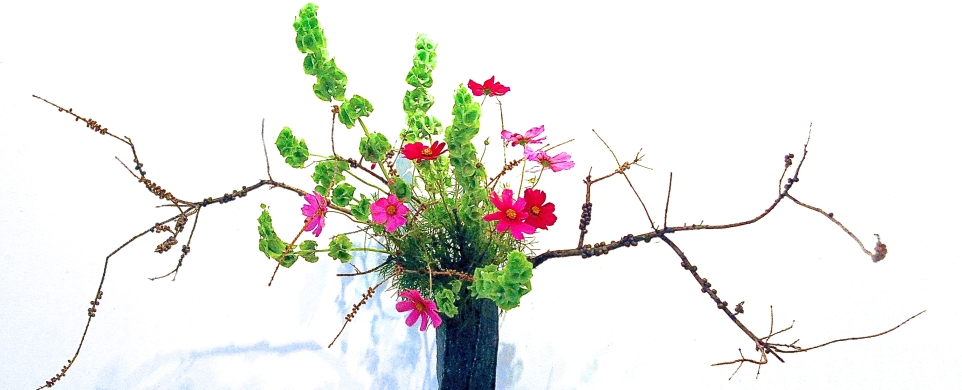
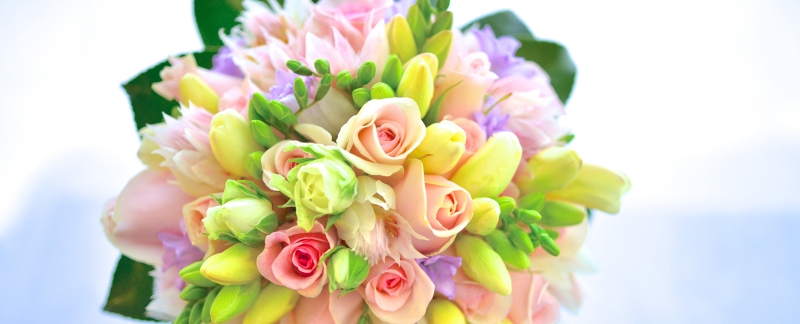
The work I show this month is a commercial boxed flower that is not too expensive and easy to carry. Can we make such an Ikebana work? Not many Ikebana artists have researched this aspect. 

I would like to let you know that my article, Ikebana in English: Bibliographical essay was published in International Journal of Ikebana Studies, Vol.2. The journal is available now. Check my site for the details. https://ikebanastudies.wordpress.com              

http://www.shoso.com.au 
https://www.facebook.com/ikebanaaustralia
Sunday, 28 June 2015


Thursday, 25 June 2015


Thursday, 4 June 2015

Ikebana Today 36


I have been discussing the meaning of the term, ikebana. It is a style of Ikebana developed in the Muromachi period, while Ikebana (with a Capital I) is the general term to encompass all styles of Japanese flower arrangement.

It is proposed that the original meaning of ikebana as well as Ikebana is to  give a new life to a  flower. Arranging flowers is like a ritual that gives new life to the dead cut flower. Ikebana may be comparable to a rite of passage.  

In Japan, births, marriages, coming of age and funerals are all rites of passage that signify the death of old self and rebirth of a new self. It is important to realise that the cut flower as material for Ikebana and a flower as Ikebana work are completely different. Arranging flowers may be like conducting a funeral or a marriage. In any case, that is how I define Ikebana.

The next question is “is Ikebana art?” 

This is my work, Heart,  that I exhibited for the Melbourne International Flower and Garden Show in 2015. It may look simple but it was very hard to make, taking us 3 days to complete. Please visit my site to see a You Tube video of our works at the show. I’m pleased that some of my students also participated in the show.

A few notices:

My course, Japanese Aesthetics: Ikebana to Contemporary Art at RMIT University will start again in July this year. Three Ikebana papers of mine were published this month, including “Ikebana in English: Bibliographical Essay in the International Journal of Ikebana Studies, Vol.2. Please visit my site for the details.      

http://www.shoso.com.au 
https://www.facebook.com/ikebanaaustralia
Wednesday, 20 May 2015

Shoso's Course at RMIT University


Shoso Shimbo will again teach  "Japanese Aesthetics: From Ikebana to Contemporary Art" at School of Architecture and Design, RMIT University from July 2015. It will be available for anyone (not just for RMIT students). This class will take participants on a journey to explore the theory of Japanese aesthetics through practical exercises. 
http://bit.ly/1IFmuyl


http://www.shoso.com.au 
https://www.facebook.com/ikebanaaustralia
Tuesday, 12 May 2015

Ikebana Today 35


A style of Ikebana (general term), the ikebana in the Muromachi period seems to mean giving new life to the cut flower. In search of the meaning of life in the Japanese cultural tradition, we came to the issue which is at the centre of Asian philosophy. It is now clear that life means essence or Kami, the divine.    

A philosopher, Toshihiko Izutsu explains the issue in the simplest way in his great book, “Consciousness and Essence” (1983), using flower as an example. He notes a comment by Fugan, a Chinese zen monk, “Seeing a flower is for many people seeing it in their dream”.

What is really happening is that a person sees a flower as a substance, which is in tact a false image. If people realise that nothing has its substance, the whole universe would be chaos. The Asia philosophy gives a new order to the chaos. Flower as well as everything else is reborn as non-substantial entity. One is all. All is one. It can be seen as a mystic or religious perception of the world. I think I had better stop here, because I never have experienced it, a kind of enlightenment at the profound level.   

Anyhow, the term, ikebana has such a philosophical context behind it. In short, ikebana means to give flower new life, reviving it as non-substantial entity. This understanding actually gives freedom to interpret ikebana in many ways. We will look at how we could interpret ikebana in the next issues.

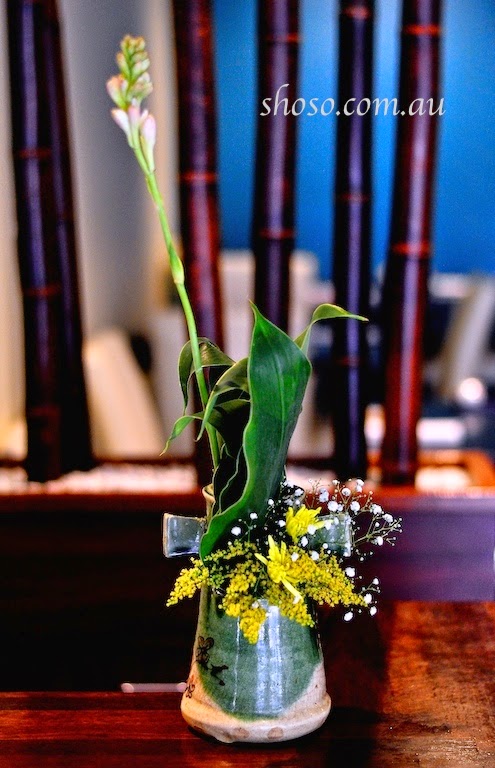
The image is my work for Hanabishi restaurant. Because I took the photo immediately after arranging flower, the colours of flowers are not so obvious. Once the flowers start to open, the arrangement looks different very day. I sometime notice that not many Japanese restaurants in Melbourne display Ikebana. Some restaurants display the western arrangements. I think Ikebana would be a better and cheaper option. Please contact me for a free quote.     

http://www.shoso.com.au
https://www.facebook.com/ikebanaaustralia
Saturday, 2 May 2015


Friday, 1 May 2015

Ikebana Today 34


It seems that in the Muromachi period, some argued that, unlike tatehana, ikebana was used to revive or give new life to the flower. Obviously, many people seem to have understood that message instantly. What did the word, Ikasu or giving new life mean to them?

Probably the best way to investigate that is to look into the documents written around that time and define how the term, Iku or Sei (life) was used. However, my intention is to propose a hypothesis that could encourage discussion rather than conducting an empirical study.

Hideo Kobayashi has argued that in Shiki Masaoka’s approach in poetry Sei means essence or even Kami (the divine). If you can express Sei in language, you can create poetry. If you can give Sei to the cut flower, you can create ikebana. Both poetry and ikebana are looking at the same issue that is at the centre of Asian philosophy.    

It is fascinating for me to look into ikebana and its meaning in terms of Asian philosophy. However, such a complicated topic does not seem to be in fashion today even in the academic fields. I may discuss this issue in much more simplified fashion in the next issues.

This is a table arrangement for a round table. The design is more like a Western arrangement. As this was for a home party on the Australia Day, the main flowers are Banksia, expressing natural movement. For the background, I chose green and yellow, Australian colours.     

I am now going to be a regular contributor for LIVING NOW magazine. I hope you will enjoy my articles on Ikebana in that magazine as well.        

http://www.shoso.com.au 
https://www.facebook.com/ikebanaaustralia

Tuesday, 28 April 2015

Ikebana in English: Bibliographical Essay


Shoso's new article, "Ikebana in English: Bibliographical Essay" is published. 

"English language literature on Ikebana, particularly academic publications, is scarce. However, a small number of non-academic publications such as introductory books or articles and collected works of artists have been constantly published for over the last fifty years. Consequently, even in generating research questions, Ikebana researchers in the West sometimes have to rely on non-academic publications which may represent the viewpoint of just a single Ikebana school. And even in academic publications, it is not unusual to encounter mystic discourses on Ikebana or legends unsupported by historical records.


This short essay is not an attempt to rectify those misunderstandings on Ikebana. Neither is it a comprehensive bibliography on Ikebana. My aim, rather, is to present a basic reference point for future research on Ikebana. It also hope to suggest areas for further research". 

Ikebana in English: Bibliographical Essay, International Journal of Ikebana Studies, Vol.2, 2014, pp.99-106


How to order a copy: https://ikebanastudies.wordpress.com/journal/
How to join the society: https://ikebanastudies.wordpress.com/membership/ 

http://www.shoso.com.au 

https://www.facebook.com/ikebanaaustralia

Friday, 24 April 2015


Wednesday, 22 April 2015

Shoso & His Students at MIFGS 2015

Enjoy the floral works by Shoso Shimbo and his students at the Melbourne International Flower and Garden Show 2015 in 2 min.

Thank you the exhibitors for your great efforts. Thank you all the assistants for your hard work.
Thank you Maddie for allowing us to use your beautiful song. We hope many people will enjoy your music.

HD: https://youtu.be/Z31-LwhP1DI


SD: https://youtu.be/cDBHBl1vDzs


http://www.shoso.com.au
https://www.facebook.com/ikebanaaustralia

Wednesday, 18 March 2015

Melbourne Flower Show 2015


Melbourne International Flower and Garden Show will open on 24 March 2015. Shoso and three of his students, Shoan (Angeline), Risa and Akemi will exhibit their works.

Thank you very much Jo, Shoan, Tian & Shosai (Jennie S.) for great help set up my work over the three days from 22 to 24 March. Especially the last day all of you worked so hard without any break. I am so grateful to have such a skilful team but I will encourage more people to join our team next time.  

I'll write more about the show in another post soon.

http://melbflowershow.com.au

http://www.shoso.com.au
https://www.facebook.com/ikebanaaustralia

Monday, 2 March 2015

Ikebana Today 33


In the Muromachi period it seems that a new style of Ikebana, known as ikebana, claimed that it gave new life to flowers, unlike tatehana, the main style of Ikebana at the time. What does it mean to give new life?

New life probably means an artistic or symbolic life rather than a biological life. The claim may mean that ikebana revives flowers by transforming them into an art work that expresses a sense of life. Such an interpretation is convincing, but it seems to be a bit superficial to me.   

What does this new life in ikebana really mean? I may be asking about the essence of ikebana and Ikebana. Although there have been some attempts to answer this question in the history of Ikebana studies, they are not really convincing.  

My first quest is to find out what life is in the Japanese cultural context. How did the people of the time perceive life? Is there any basic concept that prevails in Japanese history? “Yes, there is” is the answer from Hideo Kobayashi, a well-known literary critic from last century.     

This month I would like to show you my work for Koko restaurant in Crown Hotel. They have been a regular client during New Year for many years. Clients’ needs come first for any commercial flowers. My work has to be safe and convenient to move around. Because of many conditions my work tend to be similar every year. However, I have experimented with a few new design elements this time. 

Im planning to exhibit my work at the Melbourne Flower Show in March and give a paper at a conference of the International Society of Ikebana Studies in Kyoto. Please visit my site for the details


http://www.shoso.com.au 
https://www.facebook.com/ikebanaaustralia