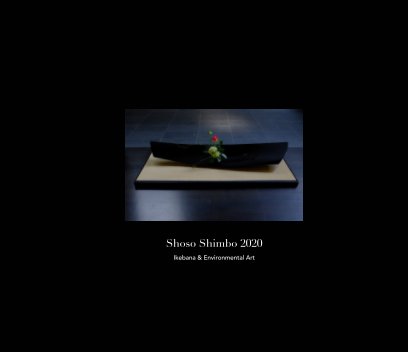
Kaikou: Chance Encounters
Shoso Shimbo's Ikebana Works with Hiroe Swen's Ceramics
Introduction
How This Book Came Into Being
In 2024, I stayed for about two weeks at the home of Hiroe in Queanbeyan, a town neighboring Canberra, and was able to devote my days entirely to arranging flowers for this collection, Kaikou: Chance Encounters. I walked along the riverbanks feeling almost absorbed into nature itself, gathering materials for arrangements. From among Hiroe's many containers, I would choose the one that felt right and immerse myself alone in the creative process. It was an extraordinarily luxurious and happy time.
Hiroe is a remarkably vigorous person. She says that she had never been conscious of any physical decline until she was past ninety years old. Each day she prepared breakfast and lunch for me. Lunch was authentic Japanese cuisine and, since she does not eat dinner, it was her main meal of the day.
After lunch, her conversations were endlessly fascinating. My wife, who came to visit and see how things were going, was impressed enough that we decided to make an interview video (YouTube: Hiroe Swen 2025 - Ikebana by Shoso Shimbo). In that interview, Hiroe spoke extensively about her philosophy of art.
She believes that art can only bear fruit when one casts aside impure thoughts and walks the proper path. Everything depends on how strictly and honestly one is able to live.
My Encounter with Hiroe
I would also like to write about my encounter with Hiroe. This was in the 1990s. I was in my thirties and had boarded a bus from Sydney to visit a friend in Canberra. That morning, I had spent hours walking along Sydney's coastline and was quite tired. I was hoping to rest quietly on the journey. However, the gentleman sitting beside me struck up a conversation. "Are you Japanese?" he asked. Usually, once such a conversation begins, the direction it will take is fairly predictable: "Where are you from?""Niigata Prefecture." "I don't know that place. I've been to Japan though. I enjoyed it very much."
But this man's conversation took a very different turn. "If you're Japanese, then surely you know my wife, Hiroe?" "I'm afraid I don't," I replied. Cornell looked astonished. "You mean you don't know the most famous Japanese artist in Australia?" From that point onward, he talked about Hiroe and himself. The conversation continued without pause until the bus arrived in Canberra. When I finally met Hiroe at the bus station, I told her: "I've already heard a great deal about you from your very talkative husband." She laughed and said, "Normally he hardly talks at all." I found that impossible to believe. "He must have taken a liking to you," she added.
Encounters in Ikebana
The starting point of ikebana is an encounter between oneself and the flower. There is also an encounter between oneself and the container. And there is an encounter between the flower and the container. Three entities come together. From there begins the search for harmony between flower and container.
One listens to the flower and listens to the container, considering how the two might be united. Yet, while making these considerations, a higher level of awareness observes one's own intentions and judgments.
During the creative process, something remarkable can occur. Personal calculation disappears, and in a state of selflessness the hands seem to create naturally on their own. Rather than "making" an ikebana arrangement, the arrangement is "born." At such moments, the act of creating ikebana becomes an experience akin to meditation.
There are also times when it becomes necessary to deliberately introduce a small measure of one's own intention into the process. In any case, personal intention never truly leads the creative process.
When personal intention takes priority, flowers and containers become nothing more than materials for self-expression. Although such positions have at times been advocated in the history of ikebana, they do not represent its essential nature. When the ego is placed first, flowers often lose their true form and seem to suffer. When the flower is given priority, traces of ego disappear from the work. The arranged flowers regain the radiance of life that they were beginning to lose as cut flowers. Indeed, they may shine more brilliantly than when they were rooted in the earth.
To restore a flower to a level of vitality surpassing even its natural state is perhaps the highest aspiration of the ikebana artist. Thus, encounters with flowers and containers form the point of departure in ikebana and guide the entire creative process.
Encountering Hiroe's Containers
I believe that many of Hiroe's finest artistic works are her containers. They make no unnecessary assertions of themselves. They simply exist. They are forms shaped by a lifetime of careful and mindful living. An ikebana artist cannot help but reach out toward them. Yet they cannot be approached casually. One must face them with a sense of tension and respect. When something is not working, they seem to say immediately "This needs to be done again." Time after time, one finds it difficult to achieve a truly satisfactory arrangement. These containers are like demanding masters. I have never encountered containers quite like them before.
I would like to express my sincere gratitude to Hiroe, to Brenton McGeachie the photographer, and to the many others who contributed to the realization of this book.
This book is dedicated to my mother, Yoshi Shimbo.