Melbourne Ikebana Festival, 29 and 30 August 2026ikebanafestival.com

Tuesday, 17 December 2013

Christmas Art in Ballarat

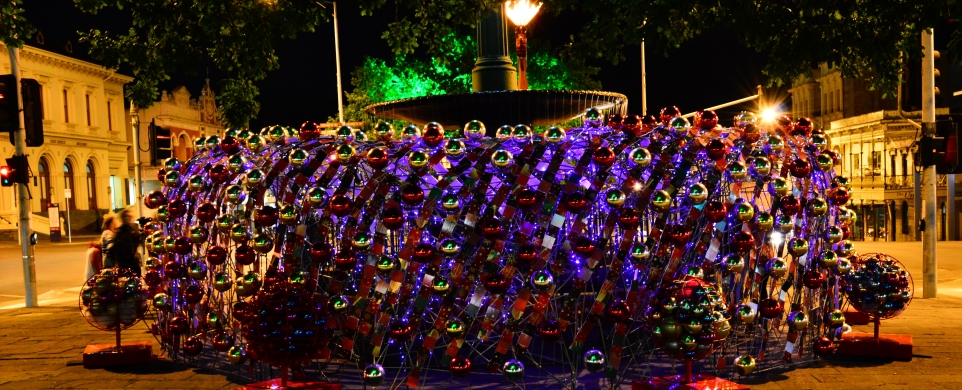
Shoso Shimbo was commissioned to create a Christmas art recycling old Christmas decorations. His work is open to public till 24 December 2013 in the CBD in Ballarat.  

Newspaper article: http://bit.ly/IRcRjP


This is the design proposal which was accepted. 


Using recycled materials is somehow similar to using natural materials. We need to prepare and transform an object to enhance its essence.


It took us four days to make this display. We worked in rain and hail.    


This photo was taken at the end of Day 2. Click the image to enlarge. 


The magical Christmas tunnel was ready at 5pm on Day 4. Thank you very much Risa Yoshimoto and Julie Collins for great help. Julie Collins is a well regarded sculptor and works for the city of Ballarat. Kate Partridge from the city of Ballarat's Community Events and the Art and Culture Unit also worked so hard for this project. Thank you very much.


We were pleased to see so many people walk through the tunnel with big smile. 


http://www.shoso.com.au 
https://www.facebook.com/ikebanaaustralia

Wednesday, 11 December 2013

Ikebana Today 18


Why did the Ikebana boom end in 1980s? My first hypothesis was that as more young women gained job opportunities they lost interest in a training to become a good house wife. My second hypothesis, which may surprise some people, is that Japanese have become too rich to be interested in Ikebana. 

Ikebana became popular because people assumed that Ikebana is an effective spiritual training which can make good house wives. Consider that assumption carefully. What do Japanese people mean by spiritual training? The basis of Japanese spirituality are positive values in Confucianism, Buddhism and Shinto. 

Questioning the common factors for those values, I suddenly realized that there is one presupposition for most of them. They presuppose that people are poor. Because people are poor, it is valuable to corporate each other harmoniously to gain maximum benefit for the community. Japanese spiritual values are extremely effective not only to overcome poverty but also to make poor people virtuous.   

Then, what happens once Japanese people have achieved wealth that they have never had after the period of rapid economic growth? Japanese spiritual values that do not teach what to overcome after poverty suddenly lose their appeal. Many Japanese people don’t know what to do with wealth. It is necessary to develop new spiritual values in rich society.      

Even if you promote Ikebana as a spiritual training, few Japanese may be interested in spiritual training itself. Generally it is called secularization of society. However, it can be a more serious problem in Japanese society than others. Declining the popularity of Ikebana could be a reflection of the spiritual crisis in Japan.


I would like to show you New Year’s decorations we made this year for Koko Japanese restaurant at crown. It’s a very simple design but there are many little inventions we created in details. We will install them again this year before Christmas.


http://www.shoso.com.au
https://www.facebook.com/ikebanaaustralia

Monday, 4 November 2013

Ikebana Today 17


I’d like to talk more about the great Ikebana boom during the rapid economic growth period in Japan. To summarise, what I have proposed so far is that the boom was strategically created by a group of people, in a similar way to the creation of a successful commercial brand.     

Of course, I think that the Ikebana boom is a fantastic cultural phenomenon and it could never happen anywhere else in the world. But why did it happen and why has it now faded? Very few people have investigated these difficult but fascinating questions.  

As I mentioned, Ikebana at that time had two sales points: as training to become a good house wife and as Western art. What we have to understand here is that these two points were contradictory. According to Mirei Shigemori who influenced many prominent Ikebana artists at that time, Ikebana had become Western art by denying its traditional spiritual aspects. Although the general public expected Ikebana to function as training for young women to learn its spiritual aspects and become good house wives, the new Ikebana in principle did not see the spiritual aspects as important.

Once the boom had passed its peak, it is natural that some people started to ask questions about the two sales points of Ikebana. I have already talked about the aspect of the training to become a good house wife. I’ll focus on the artistic aspect of Ikebana from the next issue.

The work for this month is a simple arrangement using anthuriums and iris leaves. Although it is a small work, it is an effective Ikebana work. I used this image for our new Facebook page, Ikebana Gallery. Please like it and enjoy Ikebana works from all over the world. https://www.facebook.com/IkebanaGallery    


November is a busy month for me. My work was selected as a finalist for the Deakin University Contemporary Small Sculpture Award and I will also be preparing a Christmas installation for the City of Ballarat. Please visit my site for the details. 

http://www.shoso.com.au 
https://www.facebook.com/ikebanaaustralia

Tuesday, 29 October 2013

Internet Ikebana Lesson

One of my students sent me following 2 works and asked for feedback. Please see e-learning page for my feedback. Anyone can now use our Internet Ikebana Lesson. We will soon make it much easier to use for people outside Australia. 


http://www.shoso.com.au 
https://www.facebook.com/ikebanaaustralia

Tuesday, 22 October 2013


Friday, 4 October 2013

Ikebana Today 16


In the period of rapid economical growth in 1960s and 70s, Ikebana became a brand and attracted many young women. My investigation revealed that Ikebana had two sales points at that time, as modern art and as training to become a good housewife. 

We should note that the image women sought through the Ikebana brand was a reflection of what Japanese men wished for in a woman. They wished for women who could make a nice home and who were intelligent enough to understand Western art. 

I wonder when Japanese men started to seek such women. They are often depicted in Japanese films and literature until the 1980s. That is another topic I would like to think about some other time. 

However, since the late 1980s when it became possible for women to seek equal opportunity in the work place, women started to look for a more career oriented brand. What was the brand that could make people seem intelligent and be more useful for work? 

It was probably English conversation. You may have noticed in the 1990s that more and more English conversation schools opened in your neighborhood, while more and more Ikebana schools closed. That was the end of the Ikebana boom. My discussion so far has only been an outline of the Ikebana boom and I’ll talk more about it in depth from the next issue. 

Somehow many people don’t seem to realize that I teach Ikebana in Melbourne. If you are interested, see the details in my website and join our class. Also, free Ikebana calendars for 2014 are available to download from www.shoso.com.au

I would like to show my commercial work gain this month. This is a part of our home party package that consists of 1 medium arrangement like this one and the 2 table arrangements. I used a wire ball to fix the flower for this arrangement.


http://www.shoso.com.au
https://www.facebook.com/ikebanaaustralia


Wednesday, 25 September 2013

Ikebana Exhibition 2013


Ikebana Exhibition 2013


Postponed! Sorry for any inconveniences. Instead, we will take part in the opening of the White Ribbon Day Art Exhibition at Laurel Lodge, Dandenong on 22 November. http://bit.ly/H2w7tV


Shoso Shimbo and his students present an exhibition of contemporary Japanese flower arrangements.
When: Postponed.
Where: Kings Arcade, 974-978 High Street, Armadale, Vic Australia
Free Admission

EXHIBITION WELCOME

Welcome to the Ikebana exhibition by Shoso Shimbo and his students. The aim of this exhibition is to introduce the Japanese art of Ikebana to people who may not know much about this art form and to give Shoso’s students a chance to show their works.

Ikebana developed as floral displays for the residences of the samurai class in around the 15th century. In the 16th century it was defined as an art form representing nature and as a way of spiritual training. It has played an essential role in the history of Japanese art in which there were several Ikebana booms. 

It is still one of the most popular artistic activities in Japan today. People have come to appreciate the creative and therapeutic properties of this contemplative art, not just in Japan but all over the world. Ikebana can offer a rare but easily accessible opportunity to connect with nature and people.

We are very grateful to many shops in Kings Arcade for hosting our exhibition.

Shoso Shimbo, PhD
Shihan - Sogetsu School of Ikebana

info@shoso.com.au
https://www.facebook.com/ikebanaaustralia

Friday, 30 August 2013

Ikebana Today 15


Promoting Ikebana as a form of art (Western art) created a great Ikebana boom after the war with tens millions of Ikebana students. However, the term "art" was problematic. Art is a Western concept introduced to Japan after the Meiji era. Although Tenshin Okakura proposed an influential definition of art, it is a bit hard to understand for the general public. In addition, since Modernism it seems that even Western specialists cannot agree on what art is. 

Stating that Ikebana is art means that Ikebana becomes ambiguous for the majority of Japanese people. Sofu Teshigahara insisted that Ikebana is free self-expression but that simple definition was also confusing. It's easy to see how this could cause some problems sooner or later.

Sofu was influenced by Mirei Shigemori in establishing his ideas about Ikebana. Shigemori is the most important garden designer in the Showa period and also a significant figure in modern Ikebana history. I’ll talk about his ideas on Ikebana at some other time.

The important thing at this stage of my discussion is that there were two aspects to Ikebana after the war: the general public’s view of Ikebana as a kind of  training to become a good housewife, and some schools’ view of Ikebana as art. These two aspects can produce both positive and negative results. Looking at these in relation to Japanese society at the time helps us understand the current problems of Ikebana.      

This is one of the works I made for the opening of Toko Shinoda’s exhibition at the Lesley Kehoe Galleries on Collins Street. Please don’t miss the wonderful exhibition. http://www.kehoe.com.au Ms Kehoe is one the judges for our Ikebana Gallery Award, the first international Ikebana award for Ikebana students around the world. Please visit our blog to see this year’s result. http://ikebanaaustralia.blogspot.com.au/


http://www.shoso.com.au 
https://www.facebook.com/ikebanaaustralia

Sunday, 18 August 2013

Ikebana Gallery Award 2013


The winner of the Ikebana Gallery Award 2013 has been announced. http://bit.ly/15L8LNC


Ikebana Gallery Award FAQ

Q: How can I submit my work?
A: Use Email or Facebook.

To make submission easier, we have started a Ikebana Gallery Facebook Page, https://www.facebook.com/IkebanaGallery

Now you have 2 options to submit your works.
  1. Send by email. Please see Award page in our blog for the details, http://ikebanaaustralia.blogspot.com.au/p/award.html
  2. Simply like Ikebana Gallery Facebook Page and post and share your work. https://www.facebook.com/IkebanaGallery Your post needs to be approved to appear on the wall of the page. If you don’t have a facebook account, you cannot upload your work directly. However, you can still see the page.
Q: What happens next?
A: From facebook to blog.

We hope that more Ikebana works will appear on Ikebana Gallery Facebook Page. Then, Ikebana Gallery Committee will constantly select works from the Facebook Page and publish up to about 300 works per year on this blog, Ikebana Gallery Australia. Those works on the blog will be considered for the Ikebana Gallery Award.

Q: Can anyone post on the facebook page?
A: Yes, but there are some conditions for Ikebana teachers.

Please note that the Ikebana Gallery Facebook Page is for Ikebana students. To be considered for Ikebana Gallery Award, you have to be a student of Ikebana at the time when you are submitting your work.

Qualified Ikebana teachers may submit their works to the Ikebana Gallery Facebook Page, but they have to indicate that they are teachers. Their works will not be published on our blog. http://bit.ly/1cHtQlR

Q: I’d like to know the result of the competition. How can you keep in touch with me?
A: Use Email or Facebook.

There are several options to be in touch with us and to receive updates. Easy options are either 1 or 2.
  1. Go to the Ikebana Gallery Australia Blog. Fill in and submit your email address in Follow by Email section on the right side column.
  2. Create a Facebook account. Like Ikebana Gallery Facebook Page and you will receive updates. https://www.facebook.com/IkebanaGallery 
Simply by submitting your works you are supporting this project. If you want to support us even more, visit the “Sponsors” page in this blog. http://bit.ly/1cHtQlR

Shoso Shimbo, PhD
Ikebana Gallery Australia

https://www.facebook.com/ikebanaaustralia

Sunday, 4 August 2013

Ikebana Today 14


The Ikebana boom after World War 2 was the greatest in Ikebana history. It was Sofu Teshigahara who was the driving force behind the boom. He was able to give Ikebana the status of a new brand. He was aware that promoting Ikebana as a kind of spiritual training or as training to become a good housewife would not work. 

It's often said that people who tend to seek status symbols such as famous brand clothes or sport cars are those with an inferiority complex. 

Since the Meiji Restoration Japanese have had a strong inferiority complex towards Western cultures. Western literature, films or even religions were eagerly taken up by the Japanese as if they were commercial brands. Under such conditions how could it be possible to promote Ikebana?  It would certainly not be effective to promote Ikebana as Japanese traditional culture. 

The magic word Sofu came up with was ART. Declaring that Ikebana is an art made it possible to attract over 5 million people. It has to be noted that the art at the time meant Western art. Although art was a truly a magic word to promote Ikebana, it was a curse for Ikebana at the same time. I’ll talk more about the relationship between Ikebana and art in the next issues.

This is a work I made for Hanabishi restaurant in Melbourne city. The restaurant introduced a special set menu of $68, which I highly recommend. I hope you will enjoy their refined dishes as well as my flower. I also hope that more business owners will display Ikebana for their shops or offices. There are many Ikebana artists who would like to challenge such opportunities and their fees are usually very reasonable.

http://www.shoso.com.au
https://www.facebook.com/ikebanaaustralia

Sunday, 28 July 2013


Tuesday, 9 July 2013

Ikebana Today 13


Let’s review what we have discussed so far. During the period of rapid economic growth, Ikebana became the most popular hobby among young women in Japan. Although there is no statistic data available regarding the number of Ikebana students, some reports put the number at as many as 30 million people in late 1960s. It is possible that Ikebana helped those women gain an image of sophisticated ladies desirable for future wives.Later we will look further into the meaning of the images Ikebana created at that time.   

There is one thing we need to stop and consider here. Generally Ikebana may have been accepted as ideal training for becoming a housewife. But why did so many women learn it at the first place? The fact is that women did not have equal opportunities in the labour market. Rather than spending money for gaining degrees or qualifications, many of them spent money on training to become housewives. So, if women gained more opportunities for jobs, Ikebana would become less popular.     

Let’s now consider how Sofu Teshigahara, the first headmaster of Sogetsu School led the Ikebana boom. Although Ikebana was widely accepted as training for housewives, Sofu was aware that such a notion would not have wide appeal. He needed a new strategy. He is often described as an innovator of Ikebana, due to his contribution in developing new Ikebana styles. However, perhaps his most important contribution is that he created a new meaning for Ikebana.  

What is the new meaning of Ikebana? How could he reinvent Ikebana in the light of the Japanese history from Meiji to after the war? The new meaning of Ikebana made it possible for him to attract over one million members in thirty years or so. On the other hand, the new meaning was a curse for him at the same time. I’ll talk more about it in the next issue.

This is a work I created for a trade show stand. I used the client’s logo for the design using one hundred anthuriums in test tubes. This may not be a typical Ikebana work, but that does not matter for professional artists who value clients’ need.

We are running an Ikebana competition again this year. It is becoming very interesting. Please see the awarded works in our blog.


http://www.shoso.com.au 

Tuesday, 25 June 2013


Sunday, 23 June 2013

Wedding Flowers


A basic package for wedding flowers includes a hand tied bouquet (partially wired)  and buttonholes (wired).
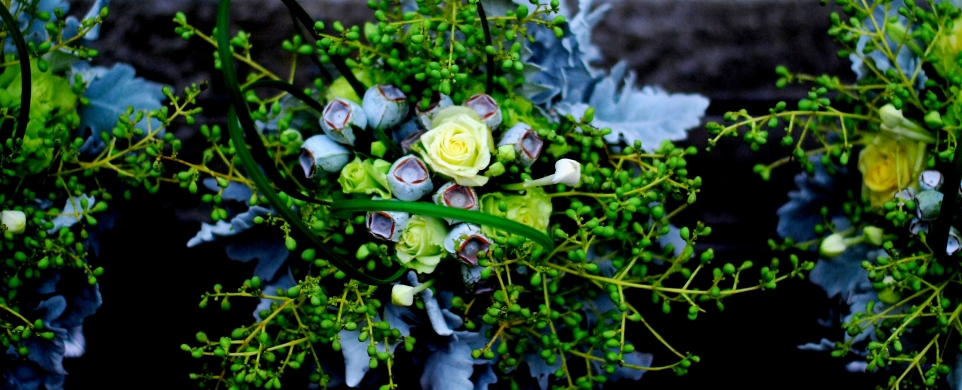
My client asked me this time to combine white lilies and calla lilies. It was a challenging combination, but it turned out to be a wonderful naturalistic round bouquet with over 30 rose heads and a French double satin ribbon.
http://www.shoso.com.au


Wednesday, 12 June 2013

Ikebana Today 12


We are investigating the Ikebana boom after the WWⅡ. It is a very complicated phenomena but one thing we can say is that most of the participants in the boom seemed to be young women. Although there are no reliable statistics about the number of Ikebana students, some estimates put it up at around thirty million between 1965 to 1975. After the period of rapid economic growth, the number gradually decreased but it was estimated to be more than ten million in 1990. It may be less than it used to be, yet it was a huge number! Why is it that Ikebana was so popular at that time?

My hypothesis is that Ikebana gained new status after the war. I have said before that Ikebana was a sign of status for a virtuous person in the Ikebana boom in the Edo period. What kind of status did Ikebana represent after the war? Certainly many women found it helpful in impressing future partners. Compared to good looks or a good academic record, being an Ikebana student is much easier and more economical. Nevertheless it had a strong effect. What was that?

To answer that question, we need to look at how the Sogetsu school promoted Ikebana after the war. It was founded in 1927 and it gained over one million members in only 30 years or so. If this was a new religious movement or some kind of social movements, there would certainly be much research into it. However, few researchers are interested in Ikebana. Anyway, the point is that Sofu, the founder of Sogetsu school gave a new meaning to Ikebana and lead the Ikebana boom after the war. I’ll talk more about that in the next issue.

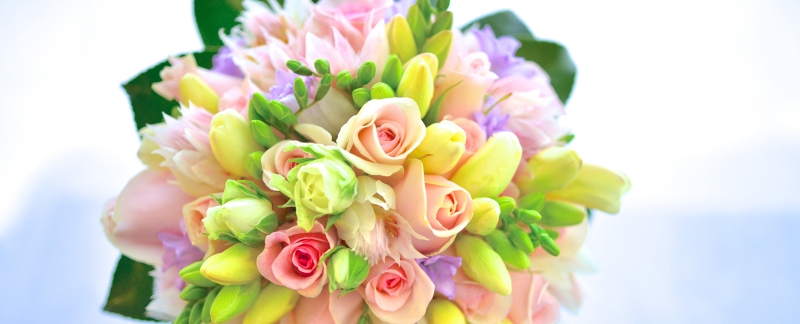
This is a wedding bouquet I made for a client who wanted me to use so many different kinds of flowers. This is a good example of how I have to as a professional balance what a client wants and aesthetic effects. 

I’ll  give a talk about Hiroshi Teshigahara at Kyoto University on 1 June. Please come if you can. Contact International Society of Ikebana Studies (ISIS) for the details. http://ikebana-isis.org/    


http://www.shoso.com.au