Melbourne Ikebana Festival, 29 and 30 August 2026ikebanafestival.com

Saturday, 9 February 2013

Ikebana Today 8


So far I have talked about how hard it is to do business with Ikebana. Since Ikebana can never promise financial rewards in the future, it can never be as popular as Western flower arrangements. Many TAFE colleges in Australia offer courses to become florists. But not many people know about Ikebana.

As to the display works, the market generally requires arrangements that are quick to install, cheap and colorfully attractive. I have to admit that the Western flowers are much better suited to such need. 

The clients for Ikebana are those who have a discerned taste and cannot not be satisfied with Western flowers. However, the number of them is rather limited, in particular outside Japan.

Generally Ikebana artists overseas are teaching a small number of students and their income from Ikebana does not reach the taxable amount. As far as I know, there are few truly professional Ikebana artists. 

Can we change Ikebana a bit so that it can adjust to the capitalistic society? I think that is possible and I do have some business plans. However, making Ikebana into business does not come to the top of my priority list at the moment. 

As one of a very few Ikebana artists who are registered as a professional artist under the Australian taxation law, there is one thing that I can say about Ikebana and business. That is there is a huge difference between commercial Ikebana works and Ikebana works as hobby. Not many people seem to realize the difference.

I happened to know probably the most famous and commercially successful Ikebana artist in Japan. I can appreciate his works only when I see them as commercial works. 

I have so far talked about anti-competitive and anti-capitalistic natures in Ikebana. The third characteristics of Ikebana I would like to focus is its malleability. Ikebana can change its form flexibly and it has been so in its five hundred years history.              

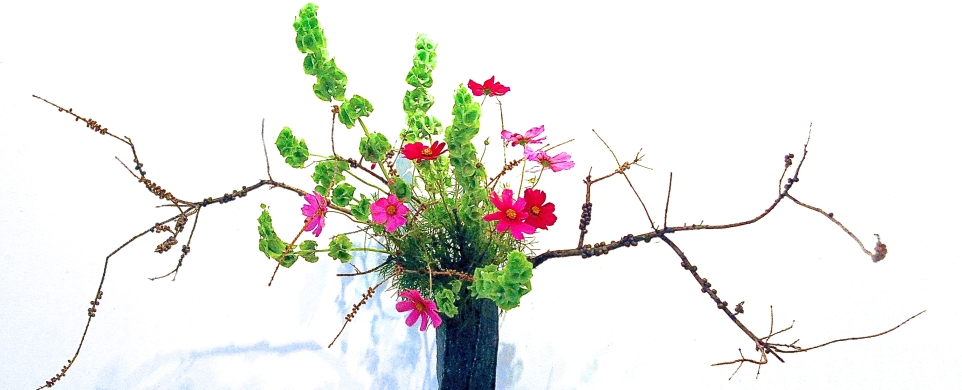
I created a naturalistic arrangement this month using Hydrangea and Jasmine from my garden. I used cross bar fixing method for this work.

My solo exhibition opens at Gallery D1.12, MADA, Monash University, Caulfield East between 10am to 4pm on 5, 6, 7 February 2013. Please come and see it.  

http://www.shoso.com.au

Saturday, 19 January 2013


Thursday, 17 January 2013

Gift Ikebana Flower


A client asked me to make a welcoming flower for his girlfriend who is moving to his house. His girlfriend likes Ikebana and he thought Shoso's work would be an ideal gift.

I chose white and green for main colour suggesting a new beginning and pale pink lilies and roses for their romantic and happy relationship.

Gift Flower Price List: http://bit.ly/1l0qrzW

http://www.shoso.com.au

Friday, 11 January 2013

New Year's Deco (Kadomatsu Style)


Kadomatsu style New Year's table decorations for Koko restaurant, Crown Hotel, Melbourne. We have tried so many options and changed so many details. Although our resources were limited, three types of Washi (Japanese paper) were used including special Chiyogami from Kyoto. Finally we are happy with this design and so was our client.  

http://www.shoso.com.au

Saturday, 5 January 2013

Ikebana Today 7


Some ikebana artists may wish ikebana to be as it used to be. The tuition fees can be expensive and teachers receive gift money on many occasions. What’s more, your works are never criticized and you gain respect in society.

However, the reality is that society is becoming more and more secular. Less people are spending money on their hobby arts or spiritual activities. This is a hard environment for ikebana artists.

If my hypothesis is right, there would be two conditions under which ikebana would be able to revive itself as a hobby art today. The first is to increase the general public’s interest in spirituality. The second is for ikebana to be widely recognized as a spiritual art. 

As to the former, there is always a potential need for spiritual activities even in a secularized society. How about the latter? How can we promote ikebana as a spiritual activity? Are there any ikebana artists who can be role models? Can you meet inspiring people in an ikebana class? Are all ikebana teachers are polite, cultured and spiritual? These are the questions that all ikebana practitioners have to think about.

The International Society of Ikebana Studies (ISIS) was founded last year. The founding members include Dr Osamu Inoue (Kyoto University), Dr Zenho Kobayashi (Kyoto Women's University), and Professor Toyoaki Watanuki (Tsukuba University). I have been appointed as a Director of ISIS. This will be a very significant organization in ikebana history. The spiritual side of ikebana will be an important aspect for ISIS to look into. http://ikebana-isis.org/

I have suggested this time that the spiritual aspect of ikebana may be getting lost today. There is a person who played an important role in lessening the importance of the moral and religious aspects of ikebana and transformed it to what it is today. I’ll talk about him sometime soon.

For the New Year’s issue I chose a bright work using yellow dancing lady. Please download from my website a free ikebana calendar for 2013 using this image. 
http://www.shoso.com.au 

Sunday, 16 December 2012


Tuesday, 11 December 2012

Toyota Sculpture Exhibition 2012: Column by Shoso


Shoso's Ikebana sculpture was again selected for this renowned contemporary art exhibition. 

Thank you all volunteers and Shoso's students who helped to make this 9m tall work. We also thank Red Cloud Bamboo for providing bamboo branches.  


When: 27 November 2012 to March 2013
Where: Toyota Australia, 155 Bertie Street, Port Melbourne
http://www.watcharts.com.au/toyota.html


http://www.shoso.com.au

Wednesday, 5 December 2012

Ikebana Today 6


In a previous issue, I proposed that one reason for the declining popularity of Ikebana could be that its history as an artistic hobby is not compatible with capitalism. In short, you cannot make money with Ikebana. 

Some people might say, “What’s wrong with that?” Others may say, “Why can't we change Ikebana?” Rather than getting into an argument about such issues, I would like to focus more on what Ikebana is today.    


Normally Ikebana artists gain some income from teaching and creating displays. Teaching is usually the main source of income, but there are few teachers, especially outside of Japan, who can make a living from teaching Ikebana. 

There are not enough students who keep studying for a long period of time. Very few students study Ikebana long enough to become aware of its spiritual aspect. Tuition fees are much cheaper here than in Japan but some students are still not happy. After all, Ikebana cannot promise any financial reward in the future, which makes Ikebana less attractive for some students.


There is another negative factor in teaching Ikebana outside Japan, which I mentioned last time. In Japan learning Ikebana used to be a status symbol to show your financial and personal status. 

In many societies, including Japan today, money is valued more than personal growth or spirituality. In these circumstances, it is hard for Ikebana to be popular, even if you promote it as a way of self-cultivation. We have to realize that the declining popularity of Ikebana is related to the global trend of secularisation.    


I made this hanging arrangement for CRYOSAUNA in Richmond. I recycled kiwi vine which was garden waste. The whole arrangement is attached to a nail on the wall using florist wire. This is a slightly abstract Christmas display full of the spirit of Ikebana.    

http://www.shoso.com.au

Wednesday, 14 November 2012


Saturday, 3 November 2012

Ikebana Today 5


In my discussion of the second characteristic of Ikebana, I pointed out the reason why Ikebana does not fit in well with capitalism is probably because it is essentially a hobby. It is not training to enhance a career, but a graceful way of spending money. In short, if you want to earn money, learn Western flower arranging, and if you want to spend money happily, learn Ikebana. 

Let’s look at Ikebana from the historical point of view. Ikebana started as a Tatebana (standing flower) style in the Muromachi period (1336-1573). It developed into the grander Rikka style early in the Edo period (1603-1867). During the mid to late Edo period, a simplified Seika style with the heaven-earth-person design principle became very popular. Development of the Seika style was significant in Ikebana history. With the stabilization of society in the Edo period, a wealthy social class emerged and they started to enjoy hobbies. The simplified Ikebana, Seika, was the perfect choice for them to learn. 

But that does not fully explain why Ikebana became suddenly so popular in Japanese society at that time. An important factor was the Japanese respect for spirituality. There was a strong demand for activities that satisfied spiritual needs. Ikebana was seen as a spiritual training that brought personal growth. 

What we need to understand here is that people with money or power were not automatically respected in Japan. What really mattered was their spirituality. This fact is often overlooked as a key aspect to understand Japanese traditional culture and its history.

Why did so many samurai lords take up tea ceremony during civil war period (1467-1573)? Because regardless of your power you were not respected if you didn't know the spiritual art of tea. This is evidence that even during war periods, Japanese people valued culture and spirituality more than economic power. We used to have quite an honorable culture.

Back to Ikebana, Ikebana became very popular not only because of the newly developed simplified style but also because there was a culture that valued spirituality.

This is a work I made for Hanabishi restaurant. If you would like to have my work for your business, please contact me. And another advertisement: my work was selected for the 2012 Toyota sculpture exhibition. Please go and see it. 


http://www.shoso.com.au

Tuesday, 2 October 2012

Ikebana Today 4


I have said previously that at first glance Ikebana does not seem to be a competitive discipline. Competition in Ikebana tends to occur in informal ways, which some may find hard to deal with.

Another characteristic I would like to focus on now is the fact that Ikebana is not compatible with today’s business world. This may be a factor in the decline in the popularity of Ikebana.

If you finish a course in the Western floristry, you can use that qualification to work for a florist or to start your own business. However, there are very few opportunities for those who have completed an Ikebana course. Ikebana is not interested in the needs of the market. This is not necessarily a bad thing. I just want to clarify what Ikebana is.

To better understand this aspect of Ikebana, we need to look into the historical development of Japanese art. There are two main streams in Japanese art forms: misemono (show) and yugei (hobby art). 

The former includes dance and kabuki. Professionals perform to meet the clients’ needs. This form of show business is very popular all over the world today. 

The second stream may be a bit harder to understand because it has some uniquely Japanese aspects. Basically it is a hobby for wealthy amateurs. It requires hard training to achieve a certain level of art, which may not necessarily be appreciated by the public. It is often regarded as a kind of spiritual training and has developed under the iemoto system. 

The interesting thing is its unique financial system. In the next issue, I’ll discuss the financial aspect of Ikebana that is based on the same system as yugei, and how this feature of Ikebana is the major factor that makes it hard for Ikebana to adjust to the contemporary capitalistic world.   

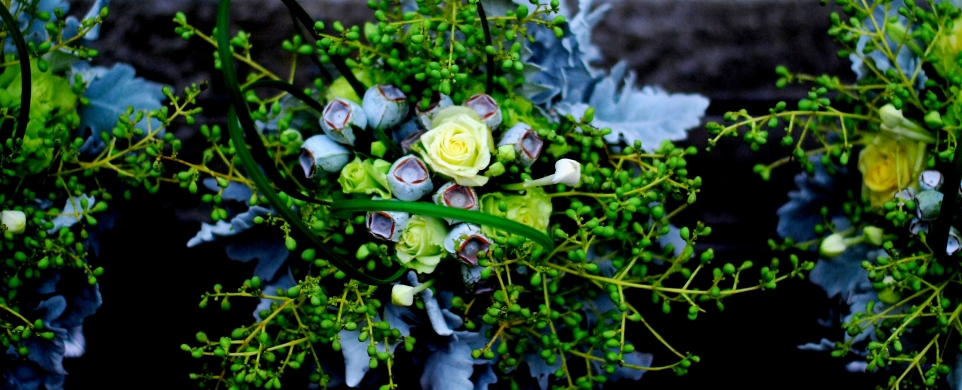
These are table arrangements I made for Ms Renouf. This is a Western arrangement using Ikebana principles. My clients often request flowers that I have never thought to use for my own works. That is a challenging and interesting aspect of making commercial works. I used oasis to fix red earthy colored roses and wax flowers. 


http://www.shoso.com.au 

Saturday, 8 September 2012

Ikebana Today 3


Let’s consider the significance of the first online Ikebana competition, Ikebana Gallery Australia Award.

As I mentioned before, competition is generally avoided in Ikebana. As a result it is hard for talented young artists to be noticed. On the other hand, talented young artists get fame and success in the Western flower, which will inevitably attract more young learners.  My concern is that this could make Ikebana less popular. Any organizations that operate without competition tend to decline.

This award is a small attempt to bring some competition into Ikebana. Some may argue that this is a small example of cultural change.

The award is getting more attention than expected. The reasons may be: 1) it brought competition to Ikebana, 2) any Ikebana student in the world can participate for free, 3) the winner receives prize money and certificate, and 4) the judges are remarkable. 

Importantly, the winner could add this award to his or her CV. Until now there has been hardly any such opportunity for Ikebana students. 

To make this award prestigious, we made the selection process very precise. With help from Dr Osamu Inoue, an Ikebana researcher from Kyoto University, our committee selected five finalists. Then we passed them to our judges. 

Ideally the judges should be those who can see Ikebana from the wider art context. Fortunately all of our four judges are just perfect: Mr Ken Smith from the Design Art and Architecture Department, Monash University, Ms Susan Renouf from the Fashion Department, RMIT University, Ms Lesley Kehoe from Lesley Kehoe Galleries and Ms Hiroe Swein, former ceramic lecturer of Australian National University. These judges alone make this award international.

The Ikebana students who participate are so lucky to receive comments from these highly regarded specialists! Normally you have to spend a lot of money and attend international flower shows to have such an opportunity.  
Please encourage anyone studying Ikebana to submit their works to Ikebana Galley.

This is a work I made for my wife’s birthday party. Her choice was pink lilies for main flowers. It kept standing throughout our busy party. I made a framework using branches and inserted the flower materials in it.

http://www.shoso.com.au

Sunday, 2 September 2012

Ikebana Students' Exhibition 2012


Shoso Shimbo and his students will present an exhibition of Sogetsu Ikebana. 
When: 22 - 28 September 2012 (Exhibition opens at noon 22 September)
Where: Kings Arcade, 974-978 High St, Armadale, Melbourne http://www.kingsarcade.com.au/

Please circulate this information to your friends and family. There will be a post about this exhibition in both Shoso's blog and facebook soon. Both have a function to share the information. 

Following is the You Tube video of our last exhibition. 


http://www.shoso.com.au 

Sunday, 19 August 2012

Message for Advanced Students


Several students in Shoso Shimbo's class are about to start our professional teaching diploma course after completing the Sogetsu certificate courses. The diploma course designed by Shoso is a demanding course that requires much more preparation, practice and your own research. 

Prior to commencing the course, just consider whether you are willing to live the rest of your life with flowers. Becoming a qualified Ikebana teacher is a lifetime commitment, although you may have to take a break sometimes in your life. It is a wonderful journey. MIllions of Japanese people bear witness to the fact that Ikebana is the best meditation to enhance their life. 

However, if you are not sure about the significance of flowers in your life, you may consider taking a break and enjoy flowers in your own way. You may also continue to study Ikebana without taking on the teaching diploma course. In considering the issues of Ikebana today this blog would be helpful.


http://www.shoso.com.au

Thursday, 2 August 2012

Ikebana Today 2


In the last issue, I started to talk about some issues that Ikebana faces today, focusing first on why the number of Ikebana students is declining. One of the characteristics of Ikebana is that it does not like competition. 


Competition does exist. If you compete too obviously in Ikebana, however, you cannot fit in to the traditional Iemoto system, which is not based on competence. This point alone could lead to a deep discussion about the nature of Japanese traditional systems of leadership.

On the other hand, Western flower arrangement is a very competitive field. There are so many competitions. If you are talented, regardless of your age, you can win a competition and gain opportunities to get attention and enhance your career. 


There are many Japanese floral designers who work internationally. They are an inspiration for younger generations.However, there are very few Ikebana artists who work internationally. Even when they do work overseas, they often depend on the local Ikebana members for assistance. This is not necessarily a bad thing. But the point is that Ikebana does not adapt to fit into other cultures easily. 

Preserving the traditional nature of Ikebana may be important. However, I think that the internationalization of Ikebana is also a worthwhile endeavor.

In order to encourage Ikebana students in Australia and around the world, I set up Ikebana Galley Australia Award. Any Ikebana students anywhere in the world can take part in the competition for free. This project is a small example of cultural change. I’ll talk about this award more next time. See this link for more details.
I made this work for the reception area of a Japanese company in Melbourne. The yellow cymbidium orchids brighten up the whole space. I used a down stick to fix the branches of Japonica. I’ll talk about this traditional fixing method in another issue. 


http://www.shoso.com.au