Melbourne Ikebana Festival, 29 and 30 August 2026ikebanafestival.com

Friday, 3 August 2018

Events Calendar


August 2018: Finalists and the winner of Ikebana Gallery Award 2018 will be announced. http://ikebanaaustralia.blogspot.com.au 

15 August 2018: A new term of Shoso’s course, From Ikebana to Contemporary Art at RMIT Short Courses will start. http://bit.ly/1IFmuyl

16 & 17 August 2018: Shoso will create 7 arrangements including a large work for a display suite for a new development in Barenya Court, Kew. This is like a Shoso’s solo exhibition! Volunteer assistants welcome.

21 September to 6 November 2018: Biennale of Australian Art. Shoso was selected for the biennale. http://www.boaa.net.au

6 & 7 October 2018: Wa Ikebana Exhibition and Workshops. https://www.facebook.com/wa.ikebana/
There is a workshop session only for men. Encourage your friend or family to join. https://www.trybooking.com/book/event?embed&eid=404074

http://www.shoso.com.au
https://www.facebook.com/ikebanaaustralia

Wednesday, 1 August 2018


Sunday, 29 July 2018


Monday, 23 July 2018


Thursday, 19 July 2018


Saturday, 14 July 2018


Sunday, 1 July 2018


Monday, 25 June 2018


Sunday, 17 June 2018

Daily Meditation: Events Calendar


29 June 2018: Ikebana workshop at Star of the Sea Collage, Brighton. Ikebana in School Program: http://bit.ly/ikebana-in-schools

30 June 2018: Deadline for Ikebana Gallery Award 2018. http://ikebanaaustralia.blogspot.com.au

29 July 2018: Ikebana worksop at Kazari, Christmas arrangements, Prahran. http://www.kazari.com.au/

15 August 2018: A new term of Shoso’s course, From Ikebana to Contemporary Art at RMIT Short Courses will start. http://bit.ly/1IFmuyl

21 September to 6 November 2018: Biennale of Australian Art. Shoso was selected for the biennale. http://www.boaa.net.au

6 & 7 October 2018: Wa Ikebana Exhibition and Workshops. Shoso's students will run a number of ikebana workshops at a special price.  

https://www.facebook.com/wa.ikebana/

Friday, 8 June 2018


Monday, 4 June 2018

Ikebana & Competition


While we try to promote Ikebana Gallery Award (IGA), we sometimes hear the statements like “Our master said that Ikebana should not be judged,” “Why do we have to compete?” There is some truth in those statements. After all, everyone is allowed to have their own beliefs or philosophies. As long as they don’t harass us or act unethically online, we can just ignore them and ask them to leave us alone. If they are persistent, all we can do is to ask them to read the mission statements on our website.

However, there are some points to make about such a narrow view on judging and competition in ikebana.

1. All of the three major ikebana schools (Ikenobo, Ohara & Sogetsu) are running their own ikebana competitions today. They recognise the benefits of competitions in ikebana. But we have to note that they are “the winners” in the field of ikebana in which there are over 1000 schools. Some of the other schools may insist that those winners’ attitudes are not always right and may even develop a negative attitude to competitions in ikebana. Instead of attacking those large schools, some of them may attack us, as we are a small and easy target at the moment.


2. Historically, competitions have always existed in the development of ikebana. However, the concept of competition in ikebana is not the same as those in contemporary professional sports, for example, where winning is highly and sometimes overly valued. 

In principle, ikebana is an inner pursuit. Our main focus is internal growth rather than what expressed externally and therefore not comparable. Accordingly, even after Western Modernism influenced ikebana in 1920’s and 1930’s, competitions that followed the style of Western art were not always well perceived. Some competitions were totally unsuccessful. History of ikebana competitions is a fascinating research topic but I won’t go into more detail here. 

Seeing some ikebana competitions being managed properly and getting appropriate attention today, however, I personally feel that ikebana practitioners are mature enough (or Westernised enough) to enjoy friendly competitions. I am confident that IGA will present a positive case study and will prove to be historically significant as a researcher has already mentioned. Everyone is a winner in IGA.

3. Ikebana discourse overseas is sometimes different from those in Japan. I hear such statement as “ikebana should be this and that” just too often. Some overseas ikebana masters (and their followers) can be more authoritative than masters in Japan. They tend to mystify ikebana. They are often angry and prone to criticise others. In addition they hate competitions. We may need to keep away from those “masters”.

4. As to the benefits and necessities of IGA, please read the following writings. http://ikebanaaustralia.blogspot.com/p/faq.html

http://www.shoso.com.au
https://www.facebook.com/ikebanaaustralia

Thursday, 17 May 2018

Ikebana Today No.70 (The Last Article)


I have been talking about the two Ikebana booms in Japanese history. The first one occurred in the late Edo period and its hit product was Seika, and the second one occurred in the Meiji & Taisho era and its hit product was Moribana. Both of them made Ikebana significantly easy to practice.

The third Ikebana boom occurred after the war. At the centre of the boom was Sofu Teshigahara (1900 – 1979), the founder of Sogetsu school. He criticised many aspects of traditional Ikebana, in particular the way Ikebana was taught. He insisted that Ikebana is art, an individual expression by each person and copying master’s works is not an artistic way of creating Ikebana. His approach was the application of Western modernism to Ikebana. Like many other examples of cultural transformation in Japan, his approach was to modify the new culture and preserve the old culture as you see fit. Although his approach was supported by a great number of people over the years, it has been criticised in many ways and I think an historical evaluation of his work will be made in the near future.

Actually, the Sogetsu school of Ikebana became more interesting for me after Hiroshi Teshigahara took over in 1980’s. However, I cannot talk about Hiroshi’s work here, because this series of essays has to end this month due to editorial circumstances at Dengon Net. I really appreciate the great support I have received from the publisher and editors of Dengon Net. I was so fortunate to be able to talk about anything I liked without worrying about readers’ feedback. Writing essays is really fun and an easy thing for me to do and I could keep writing much longer. But it may be a good idea to take a break here and look for a new direction. Thank you very much, staff and readers of Dengon Net. Thank you also Julie, my partner and Pat, my mother in law for checking my English essays for such a long time, over nearly ten years.

http://www.shoso.com.au
https://www.facebook.com/ikebanaaustralia

Ikebana Today No.69


Ikebana booms in Japan were socio-cultural phenomenon. Looking into their history helps understand Japanese society better. I hope some will investigate them in a more academic context. Such research may also reveal the secrets of how to succeed in business. One of them seems to be simply providing innovative and attractive products responding to clients’ needs. 

I’d like to make a few comments on the Ikebana boom in the Meiji (1868 - 1912) to Taisho era (1912 - 1926) . Prior to this boom Ikebana was taught in private. Teachers did not set the tuition fees, and the students payed according to their financial situations. I sometimes think that might be a good system. I set my tuition fees rather low so that I can train as many competent qualified teachers as possible in a shortest period of time. However, I may change my approach shortly. Those who join the class because of rather cheap fees don’t usually complete the long journey of learning Ikebana. Setting fees low does not necessary help achieve my goal. Anyway, it was after this boom that a group lesson in a classroom was introduced with set fees.

Traditionally most Ikebana teachers were male. However, number of female teachers increased significantly during this boom. Reason? A large number of Japanese men died during the Sino-Japanese War (1894 - 95) and the Russo-Japanese War (1904 - 05). Becoming an Ikebana teacher was attractive, but often one of the limited choices for some war widows.   

It is also notable that kenzan played a important role in this boom. It seems that it was invented during Meiji and had been reinvented after that. As I mentioned last month, Moribana was the hit product after Taisho era. Its easiness and popularity depend largely on kenzan.   

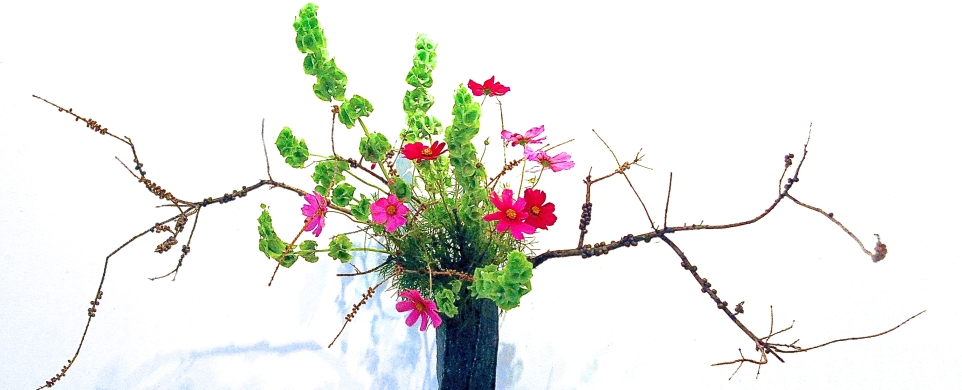
This is a work I made for my client at their home party. Rather unusual combination of materials made this work interesting. In April I’ll present a paper at the International Academic Forum in Kobe, and at a university in Romania. That must be a good time to see sakura.      

http://www.shoso.com.au
https://www.facebook.com/ikebanaaustralia
Wednesday, 16 May 2018

Tuesday, 15 May 2018

Keeper of Water: At the Lorne Sculpture Biennale 2018


Originally inspired by Daniel McCormick’s watershed sculpture, this project, a storm water filtering dam, is a small scale environmental sculpture using organic materials. It symbolises a desire to protect our waterways. The aim of this kind of organic dam is to slow, filter and cleanse the water (through sand bags, willow branches and charcoal) before it joins the river. Being made of organic and biodegradable materials, the sculpture would eventually become a part of its environment. This project encourage community members to join in production, learning how to recycle natural wastes to create a practical solution to environmental problems.

http://www.shoso.com.au 
https://www.facebook.com/ikebanaaustralia