
Join Zoom Ikebana Dojo Level 3, the most advanced course in Ikebana Dojo: Details
We welcome advanced practitioners of ikebana who would like to teach ikebana as meditation.


February 2022: New term starts for our Certificate Courses
5 February 2022: Zoom Ikebana Dojo Level 3.3
5 February 2022: Ikebana Introduction
19 February 2022: Zoom Ikebana Dojo Level 3.4
19 February 2022: Ikebana Introduction
5 March 2022: Zoom Ikebana Dojo Level 1, Part 2 (New Intake)
5 March 2022: Zoom Ikebana Dojo Level 3, Part 2 (New Intake)
5 March 2022: Ikebana Introduction
6 March 2022: Ikebana Workshop at Villa Alba Museum
19 March 2022: Ikebana Introduction
30 March - 3 April 2022: Melbourne International Flower & Garden Show
9 April 2022: Ikebana Introduction
11 April 2022: Ikebana Workshop for Richmond Library
30 April 2022: Ikebana Introduction
14 May 2022: Ikebana Conference (International Society of Ikebana Research)
10 June 2022: Ikebana Workshop for Richmond Library
31 August 2022: Ikebana Workshop at the National Hotel, Richmond
10 & 11 September 2022: Wa Melbourne Ikebana Festival. https://www.ikebanafestival.com


25 - 31 December 2021: Entries open for the Ikebana Gallery Award 2022.
15 January 2022: Zoom Ikebana Dojo Level 1
15 January 2022: Ikebana Introduction
15 January 2022: Ikebana Conference - ISIR
February 2022: New term starts for our Certificate Courses
5 February 2022: Zoom Ikebana Dojo Level 3.3
19 February 2022: Zoom Ikebana Dojo Level 3.4
30 March - 3 April 2022: Melbourne Flower & Garden Show
5 - 7 April 2022: Art of Bloom, NGV
10 & 11 September 2022: Wa Melbourne Ikebana Festival. https://www.ikebanafestival.com

4 December 2021: Ikebana Introduction Workshop
11 December 2021: Zoom Ikebana Dojo Level 3.2 (Application Closed)
December 2021: Entries open for the Ikebana Gallery Award 2022.
15 January 2022: Zoom Ikebana Dojo Level 1 - New Term for Online Course
15 January 2022: Ikebana Introduction Workshop
29 January 2022: Ikebana Introduction Workshop
2 February 2022: New term starts for our Certificate Courses
5 February 2022: Zoom Ikebana Dojo Level 3.3 (Application Closed)
5 February 2022: Ikebana Introduction Workshop
19 February 2022: Zoom Ikebana Dojo Level 3.4 (Application Closed)
19 February 2022: Ikebana Introduction Workshop
30 March - 3 April 2022: Melbourne Flower & Garden Show
5 - 7 April 2022: Art of Bloom, NGV
10 & 11 September 2022: Wa Melbourne Ikebana Festival. https://www.ikebanafestival.com


6 November 2021: Ikebana Introductory Class
6 November 2021: Ikebana Certificate Courses restart (term 2).
20 November 2021: Ikebana Introductory Class
27 November 2021: Zoom Ikebana Dojo Level 3.1
11 December 2021: Zoom Ikebana Dojo Level 3.2
December 2021: Entries open for the Ikebana Gallery Award 2022.
February 2022: New term starts for our Certificate Courses
5 February 2022: Zoom Ikebana Dojo Level 3.3
19 February 2022: Zoom Ikebana Dojo Level 3.4
30 March - 3 April 2022: Melbourne Flower & Garden Show
5 - 7 April 2022: Art of Bloom, NGV
10 & 11 September 2022: Wa Melbourne Ikebana Festival. https://www.ikebanafestival.com


Prerequisites
Please note that Ikebana Dojo Level 3 is not a normal online course and is specifically for advanced students of ikebana. It is designed to be an aid to individual learning rather than a comprehensive learning program. Participants are expected to be proactive and complete homework in every session.
Ikebana Dojo Level 1 & 2
Our focus in Level 3 is on freestyle ikebana.
We have learnt about four major ikebana elements and four major ikebana principles in level 1 & 2. In level 1 we learned about four major ikebana elements and four major ikebana principles through making basic free styles.
Line 1, Form 1, Space 1, Colour 1
Balance 1, Movement 1, Contrast 1, Pattern 1
Barrett (2011:43) states about the relationship between elements and principles as follow:
“Design elements may be thought of as the bricks of a building and design principles as the means by which you put elements together to construct a substantive building”.
If we use 1 element and 1 principle to make an ikebana work, we have at least 16 types of combinations.
Space X Balance
Space X Movement
Space X Contrast
Space X Pattern
Colour X Balance
Colour X Movement
Colour X Contrast
Colour X Pattern
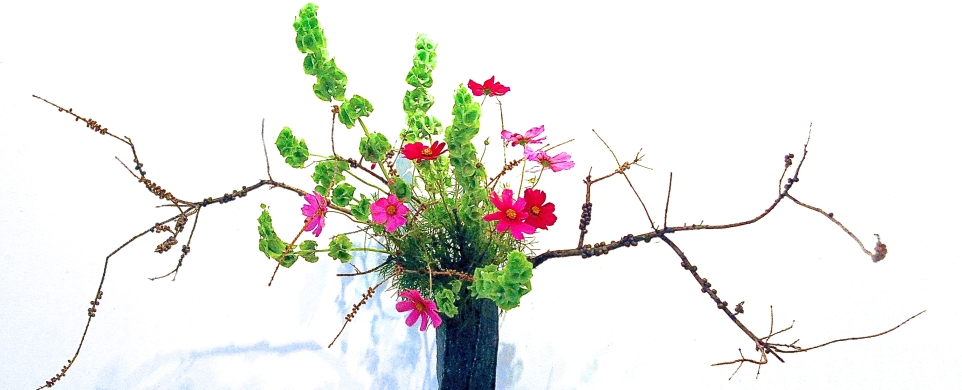
Form X Balance
Form X Movement
Form X Contrast
Form X Pattern
Line X Balance
Line X Movement
Line X Contrast
Line X Pattern
In addition, we sometime use two or more elements in one work. So the possible combinations could be much more.
Do we need to learn all of them? Isn’t it too confusing to learn them? Don’t worry.
We have learned the basic styles in level 2.
Line 2, Form 2, Space 2, Colour 2
Balance 2, Movement 2, Contrast 2, Pattern 2
Although we have focused on single elements and principles one by one in each lesson, to make an ikebana work you were always combining elements and principles. That is exactly what you did in learning the basic styles at level 2. Successful basic styles inevitably contain and use multiple elements and principles effectively at the same time.
If your basic styles have achieved harmony successfully, you have actually learnt almost unconsciously which combinations are effective. Making basic styles is a very effective way to learn how to make harmony in ikebana. It’s a pity that so many people underestimate the importance of practicing basic styles.
Design as Means
However, you are going to learn to move away from focusing on the design elements and principles too much at level 3. Learning about design is essential for beginners and always useful for advanced students as well.
But Ikebana is not about design. Our goal is creating harmony or poetry in ikebana (Shimbo, 2021). Knowing the difference between design and harmony is very important. While the former is visible, the latter is intuitive, beyond analysis. True ikebana comes from meditation and your unconsciousness rather than your analytical thinking.
That feature may be a fundamental difference between ikebana and other flower arrangements including Western flower arrangements. It seems that a goal of Western flower arrangements is beauty in design. Their focus seems to be the design and techniques that the artists applied on natural materials. Their interest is in what a person does, i.e., person rather than nature.
On the contrary, design is not a goal but means in ikebana to achieve its goal, symbolic representation of nature. Our interest is not in the marks artists made on natural materials but in what artists perceived in them, i.e. nature rather than person. Good designs and techniques may help convey their intuitive perception of essence of life, which is at the same time the essence of ikebana, harmony or poetry. But design alone is not suffice to capture the essence of ikebana.
Therefore, you cannot learn ikebana like you learn Western flower arrangement. A different attitude is required. The ikebana workshops focusing on designs or techniques may be useful, but they can be meaningless if they ignore the true goal of ikebana.
Goals of Level 3
Our goal is not making “your ikebana” or “you in ikebana”. We have seen so many works of self-expression using flowers. In many cases the flowers in those works don’t look alive. It seems that in those works flowers are treated as dead not as living. Artificial flowers would be better suited for such works. If flowers are used just as colours or design elements, it is impossible to express life in nature, which is the essence of ikebana.
In fact, at level 3 we would like you to shift your focus from design elements and principles to harmony, from visible to invisible, from conscious analytic thinking to unconscious deep feeling. A key is to be absorbed in the process of making.
Why do we encourage you to forget thinking about design elements and principles?
Because if you are thinking about designs, there is separation between you and your work as a result of your thinking on design. You as a subject recognise your work as an object. That prevents you from going further. Try to remove such a division and become one with your work so that you can recognise more than designs in your materials and your work.
Suido Yamane (1893 - 1966), one of the most significant ikebana masters in modern Japan, talked about giving up our small self (probably he means analytical conscious ego) and living in our large self (probably similar to the Self in Jungian psychology) (Yamane, 1967: 98).
“Ikebana artists can transform their state of mind freely by becoming selfless (becoming free from any restricted notions), and by accepting others (sacred love or Buddha’s mercy represented in flowers and branches or great love or the source of life in the universe). You can create true ikebana only through giving up your small self and living in your large self. In a sense the way of flower is a way of enlightenment”.
As mentioned, our goal is not self-expressions using flowers. To be more precisely, we are not interested in the expression of your small selves.
Traditionally Japanese masters often taught us to talk to our flowers in making ikebana. In other words, love your materials and enjoy making ikebana. That may be the first step to letting your small self go.
Topics in Level 3
As our goals are rather special, we have to use unique strategies to achieve them. It is participants responsibility to fully understand the course and use it effectively in their personal development as an ikebana artist.
Our level 3 consists of two core programs, Line & Form, which are the more fundamental in creating ikebana among the four major elements. It is very useful to learn to see lines or forms in natural materials at the start of making ikebana.
Level 3 Line covers the following four topics.
Line X Balance
Line X Movement
Line X Contrast
Line X Pattern
Level 3 Form covers the following four topics.
Form X Balance
Form X Movement
Form X Contrast
Form X Pattern
Three Step Learning Model
While we focus on the combination of one element and one principle to begin with, you will need to think about all elements and principles in the process of making ikebana, and at the same time you are expected to forget all about designs when you finish making it.
That is our 3 step learning model in Level 3: start with a small aspect of design, think of all aspects of design and forget all about design. This is the recommended process of learning you have to manage each time by yourself.
At the end of the course we hope you will be able to enjoy ikebana more than ever, and that you will feel that you can make harmonious ikebana works with any materials anytime.
References
Barrett T. (2011). Making art: Form and meaning, NY: McGraw Hill.
Shimbo, S. (2021). Ikebana: Flower Arrangement in Search of Poetry, Garland Magazine.
Yamane, S. (1967). Message for those who live for flowers, Tokyo: Chuo Koron Bijutsu Shuppan.
How to Apply/Participate


Shoso talked about Ikebana and Japanese garden in the ABC's Gardening Australia. Click the image or visit this to see his story. http...