Melbourne Ikebana Festival, August 2028ikebanafestival.com

Friday, 21 October 2011


Thursday, 6 October 2011

About learning Ikebana


It may help for new students to know about the learning model in Ikebana.  Without that knowledge you may get frustrated in the first or second lesson. Learning Ikebana is a bit different from learning cooking or how to use a computer software, for instance. It is even different from learning some crafts such as western flower arrangements. It is more like learning dance or martial arts.

In the research of second language learning, in the 1980s an American researcher proposed an influential theory that distinguishes language acquisition from language learning. This theory is very helpful to understand the nature of learning Ikebana.

Our aim is not Ikebana learning but Ikebana acquisition. In the first lessons all you learn is how to create a basic design framework. Even if your teacher gives you positive feedback, you might feel that your work is not quite right. Indeed, your work is usually far from perfect. But that is OK. Acquiring Ikebana takes time. 

If you arrange private tuition rather than joining a group class in Ikebana, you may learn much more in one lesson. You may be able to make a near perfect basic style arrangement following the detailed instructions of your teacher. But can you really acquire Ikebana rather than learn Ikebana in the lesson? In other words, can you make another near perfect basic style by yourself after the lesson? Probably not. 


Even if you master grammar and pronunciation in the classroom, you may not be able to communicate very well in the second language. Learning a second language as knowledge does not help you much. 

But if you learn and use the language in real communication, you have a better chance of really acquiring the language. Language acquisition gives you the freedom to communicate and express yourself in the second language.

After the first lesson in a Salsa dancing class, you would not expect to be able to dance like a pro. All you can do are the basic steps. Although they are very simple movements, you need to practice a lot before you can go to the next step.

Then, your fee (private lessons would be 10 times more expensive) and the teacher's time may not be utilised well, although I would not say wasted. You may be able to learn Ikebana but you will not acquire Ikebana in one lesson. 

Only when you have acquired the basic design framework after practicing it a few times are you ready to move on to the next challenge. That's how the acquisition of Ikebana occurs. Only Ikebana acquisition gives you the freedom to make good Ikebana works with any materials under any conditions. Ikebana acquisition takes time, so be patient.    

http://www.shoso.com.au 
http://shososhimbo.blogspot.com/

Tuesday, 4 October 2011

The Ten Virtues of Ikebana 6


The sixth of the ten virtues of Ikebana is constant scent. 
If you take up Ikebana, you can always be surrounded by the nice smell of flowers. 
Ikebana artists know which flowers work best for them and their family and friends. My favourite is a sweet olive, osmanthus fragrans. I was delighted to find this plant is available in Australia as well as in Japan and it’s growing so well in my newly planted garden.
As any aroma therapist will tell you, scents really affect our moods and feelings. Even when we feel a bit depressed, the scent of flowers always cheers us up. That effect should not be underestimated. It can be more than a temporary change in psychological state. 

Especially when we are really stressed or anxious about something, scents can help us stop our negative thinking and gain new insights. For instance, we may realise we were losing sight of the more important things in our lives. Such an experience could help us lead a more spiritual life. That’s the power of flowers. Don’t you feel like taking up Ikebana now?
I used a cube shape container for this month’s work. I put a cross bar inside the container to fix flowers. To emphasise the zigzag features of the container, I used Japonica branches which have zigzag lines. I place a yellow gerbera as an accent at back of white stocks for a naughty effect. 


http://www.shoso.com.au
http://shososhimbo.blogspot.com/

Monday, 3 October 2011

Recent Work: Royal Melbourne Show 2011

Flowers Victoria organised floral competitions for the first time during the Royal Melbourne Show. I was invited to participate in a competition where 12 florists in Victoria were selected.

http://www.shoso.com.au
http://shososhimbo.blogspot.com/

Monday, 19 September 2011


Friday, 16 September 2011

Recent Work: Bridal Bouquet


Round bouquet is a very popular style for wedding. This is a hand tied bouquet, not wired but I was able to create a completely round form. Tips to make a good round bouquet are;

1. Hold a bouquet at your eye level in making it.
2. Don't follow the professional instructions on You Tube. They are just too skilful. They make bouquets so easily and encourage you to make them like them. However, without years training, you can never make like them.
3. Work with your assistant. That's the secret I found. The professional florists do not tell you that!

http://www.shoso.com.au
http://shososhimbo.blogspot.com/

Tuesday, 13 September 2011

The Ten Virtues of Ikebana 5


The fifth of the ten virtues of Ikebana is gaining respect. This means that Ikebana helps personal development and as a result Ikebana practitioners will gain respect. 

However, this does not simply mean that if you become Ikebana teacher you will be respected by many. If you expect to be respected by just practicing and teaching Ikebana, that would be wrong. If you don't understand this fully, you might become an arrogant teacher, which is sad.

People with academic carrier or background may be called “teacher”.  Becoming ikebana teacher does not require any formal education. But Ikebana training is not substitute for formal educational training.

Then, how should  we interpret the fifth virtue? Ikebana gives you a status of “teacher” regardless of your formal education or background, therefore you have to make effort to be deserved to it. Focus is not the result but the process which could be long and could require much efforts. 

If all you read is women’s magazines, all you watch is silly variety shows and never read Shoso’s articles, you are not making enough efforts (ha)!

This is the work I made for Ms Renouf. Making works for clients is different from making Ikebana for yourself. You are expected to go beyond clients’ expectation under often challenging conditions. “You are amazing! Flowers were divine!” Receiving such comments, my efforts were worthy. 

http://www.shoso.com.au http://shososhimbo.blogspot.com/

Tuesday, 23 August 2011


Friday, 12 August 2011

From Shoso's Gallery: ABC Gardening Australia Expo 2008


Rejuvenation
In this work I have returned to the theme of light returning to the world, as in the story of Ameterasu, the Japanese Sun Goddess, who hid herself in a cave and denied the world her light, then emerged to shine her light on the world again.
After a long period of darkness, light finally begins to shine again, starting with a small gap in a dark wall, which in fact has its own beauty. As the light breaks through, the joy of light after darkness, of hope in bleak times is seen as the floor material reaches up to bathe in the light’s reflection. 
The energy of light brings bright colours to life, while the dormant world still waiting for its touch remains a pensive green. Light is not seen in this work, only the response of the natural world to its presence.


http://www.shoso.com.au
http://shososhimbo.blogspot.com/

Friday, 5 August 2011

Shoso on TV


I talked about Ikebana and gave a quick demo for a popular morning TV show. I often use this video in my Ikebana workshop as an introduction. It's short and contains great information.                  

http://www.shoso.com.au
http://shososhimbo.blogspot.com/

Thursday, 4 August 2011

Recent Work: Party Flower


Ms Renouf asked me to make three Ikebana arrangements for her home party in July. This colourful work is a welcoming flower for her guests. Following is a wonderful comment from her.


Dear Shoso,

I meant to call earlier to tell you how DIVINE the flowers are.
You are amazing.

My guests were enthralled, particularly with the one "they will never see again " I think you will have to master it so you can do it more quickly and easily, as it is SUPERB !
Many, many thanks,
Susan


http://www.shoso.com.au 
http://shososhimbo.blogspot.com/

Saturday, 30 July 2011

The Ten Virtues of Ikebana 4


Ikebana helps us learn about many kinds of flowers and trees with very little effort. We learn their names, and we become in tune with the seasons and nature.
But you may ask “how come knowing about plants can be a virtue?” or “What kind of benefit does it give?”                        
To answer these questions, first we have to consider the definition of virtue. It is not about benefitting yourself but being of benefit to others. Just like people respect cultured people, they also respect virtuous people.                                   

These values can be seen as kinds of goals for us to achieve in our lives, although getting rich seems to be the only goal in life for many today.

However, there are some who respect those who have a great knowledge of plants. In particular, we learn how short the life of a flower is. 

This in turn, makes us realise how short our life is. We all have many attachments and desires. We hope for wealth or fame or success in our short lives. How small and meaningless those goals are!
Whether people respect your knowledge or not, you will come to realise how valuable that knowledge is. Then you will agree with the idea that learning about plants is a virtue.
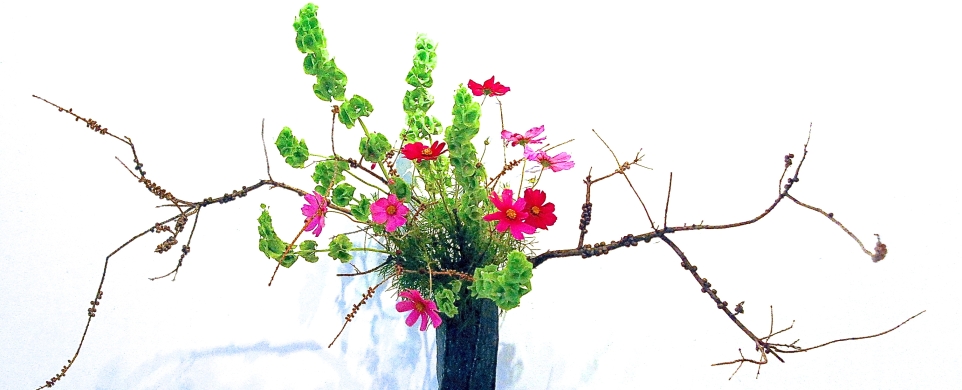
This is another simple work. Three calla lilies are put together using a toothpick and a rubber band. Attach them to a short stem. Then, place the stem inside the glass container. Hide the base using a dracaena leaf.


http://www.shoso.com.au 
http://shososhimbo.blogspot.com/
Friday, 22 July 2011

Recent Work: Wedding Flowers


Bridal Tied Posy (not wired)
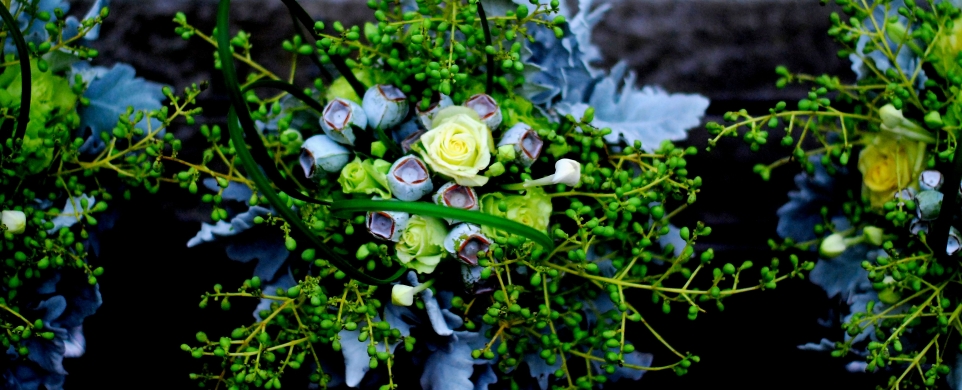
Materials: Roses, Lisianthus, Queen Fabiola, Silver Suade.


Working with a bride to be is always exciting and challenging. Notice that white Queen Fabiola is creating an interesting, almost playful effect for this round bouquet. Following is the comment from the bride.

"Thanks again for the bouquets and button holes. They were beautiful and we received many positive comments about the flowers. Arigatogozaimashita!" 

http://www.shoso.com.au http://shososhimbo.blogspot.com/
Friday, 15 July 2011


Wednesday, 13 July 2011

From Shoso's Gallery


Melbourne International Flower and Garden Show 2010

After Mondrian: A Celebration

This installation was inspired by the works of the Dutch artist Piet Mondrian (1872 – 1944). Robert Hughes says of Mondrian: "All his paintings are about the disentangling of essence from attributes: the enunciation of what is central, and what peripheral, in his experience of reality."

This work is a celebration of line and colour. The central section is a formal study of how line and colour influence composition. 

I used lemons with the yellow dahlias to create a sense of depth in the solid block of colour. Similarly the varying hues of red in the apples and the peppers and the combination of the purple statice and the blue delphinium add texture and draw the eye in deeper. The seeds also make a nice contrast to the darker colour of the pods.

The outer sections move into a freeform exploration of line in nature. I wanted to contrast the sharp definition in the central section with the random way in which lines form in nature. I’ve used some recycled pink netting as a backdrop and some asparagus fern and roseberry to emphasise the beautiful shape of these branches I rescued from a hard rubbish collection in my neighbourhood.

http://www.shoso.com.au 
http://shososhimbo.blogspot.com/